
United States v. Forty Barrels and Twenty Kegs of Coca-Cola, 241 U.S. 265 (1916)
United States v. Forty Barrels and Twenty Kegs of Coca-Cola, 241 U.S. 265 (1916), was a federal suit under which the government unsuccessfully attempted to force The Coca-Cola Company to remove caffeine from its…
Cryptanaerobacter phenolicus transforms phenol into benzoate via 4-hydroxybenzoate
Benzoic acid occurs naturally in many plants and serves as an intermediate in the biosynthesis of many secondary metabolites. Salts of benzoic acid are used as food preservatives. Benzoic acid is an important precursor for the industrial…
Rhodococcus phenolicus is a bacterium able to degrade phenol as sole carbon source
Rhodococcus phenolicus is a bacterium species in the genus Rhodococcus. Phenolicus comes from New Latin noun phenol –olis, phenol; Latin masculine gender suff. –icus, suffix used in adjectives with the sense of belonging to; New Latin masculine gender adjective phenolicus, belonging to phenol.…
Farnesol and Farnesene
Farnesol is a natural 15-carbon organic compound which is an acyclic sesquiterpene alcohol. Under standard conditions, it is a colorless liquid. It is hydrophobic, and thus insoluble in water, but miscible with oils. Farnesol is produced…

Temporins and Musth or must
Temporins are a family of peptides isolated originally from the skin secretion of the European red frog, Rana temporaria. Peptides belonging to the temporin family have been isolated also from closely related North American frogs, such as Rana…
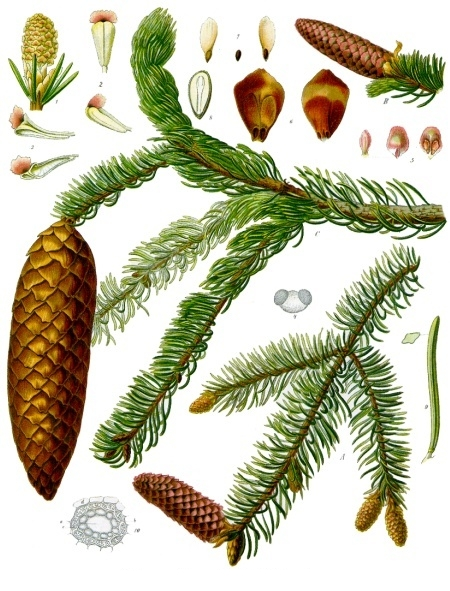
Piceol is a phenolic compound found in the needles and in mycorrhizal roots of Norway spruces and more
Piceol is a phenolic compound found in the needles and in mycorrhizal roots of Norway spruces (Picea abies). Picein is the glucoside of piceol. Pungenin is a also phenolic compound found in the needles of Blue Spruce (Picea pungens). It is…